
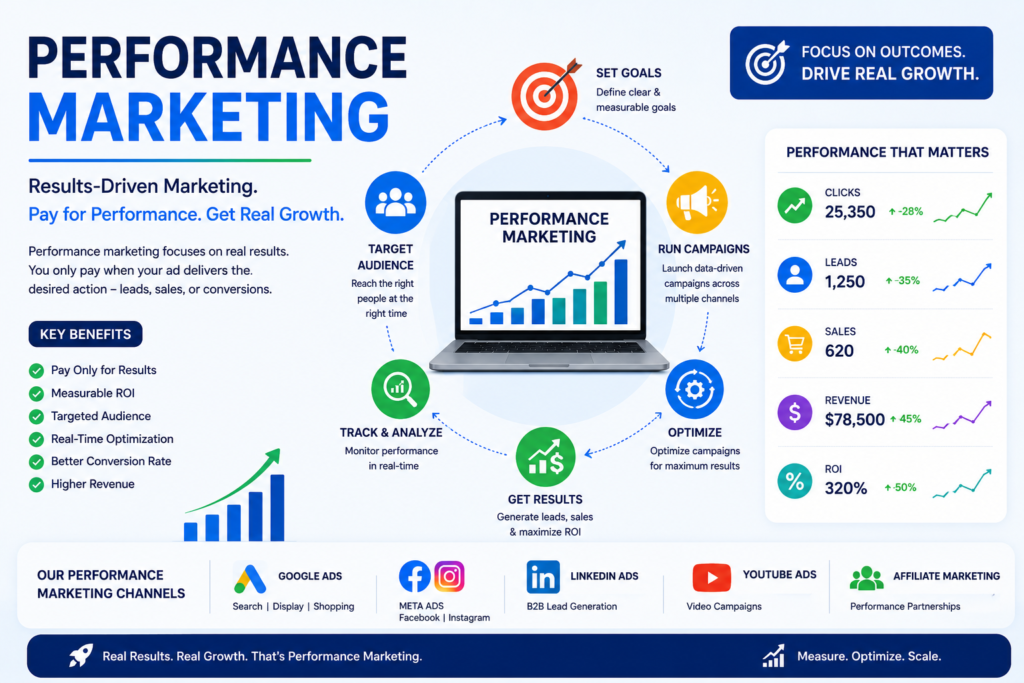
In today’s digital-first world, businesses want marketing strategies that do more than just create visibility. They want measurable growth, quality leads, better conversions, and a clear return on investment. This is where performance marketing becomes one of the most valuable strategies for modern businesses. Unlike traditional marketing, where results can be difficult to track, performance marketing focuses on actions that can be measured directly. These actions may include clicks, leads, sales, app installs, sign-ups, or any other conversion that supports business growth.
Performance marketing has become a preferred choice for startups, local businesses, eCommerce brands, and large companies because it combines data, strategy, and measurable results. Instead of spending money only to gain impressions or awareness, businesses can focus on outcomes that directly impact revenue and growth. With the right approach, performance marketing helps brands reach the right audience, reduce wasted ad spend, and scale campaigns that produce real business value.
What Is Performance Marketing?
Performance marketing is a digital marketing strategy in which businesses pay for specific results rather than simply paying for ad placement or visibility. These results can include website visits, lead form submissions, purchases, phone calls, app downloads, or other actions that match business goals.
The main advantage of performance marketing is accountability. Every click, conversion, and campaign action can be tracked, analyzed, and optimized. This gives businesses a clear understanding of where their marketing budget is going and what return it is generating.
Performance marketing often includes channels such as:
- Google Ads
- Meta Ads
- YouTube Ads
- Display Advertising
- LinkedIn Ads
- Affiliate Marketing
- Remarketing Campaigns
- Shopping Ads
These channels work together to attract, engage, and convert potential customers across different stages of the buyer journey.
Why Performance Marketing Matters For Business Growth
Performance marketing matters because businesses today need strategies that are efficient, measurable, and scalable. It is not enough to simply promote a brand online; businesses need to know which campaigns are bringing leads, which ads are driving sales, and how to improve results over time.
Key Benefits Of Performance Marketing
- Focuses on measurable business outcomes
- Helps generate qualified leads and sales
- Reduces wasted advertising spend
- Improves return on investment
- Supports data-driven decision-making
- Allows continuous campaign optimization
- Helps businesses scale successful campaigns
- Works for both local and global audiences
For businesses looking to grow faster and market smarter, performance marketing provides a strong foundation.
How Performance Marketing Works
Performance marketing works by connecting paid digital campaigns with specific business goals and measurable actions. The process usually starts by identifying what success looks like. For one business, success may mean getting more service inquiries. For another, it may mean selling products online. Once the goal is defined, the campaign is built around the right platform, audience, creative strategy, and conversion path.
A simple performance marketing flow looks like this:
- Define the business goal
- Choose the right advertising platform
- Identify the target audience
- Create ad creatives and messaging
- Build or optimize landing pages
- Launch the campaign with tracking
- Measure clicks, conversions, and costs
- Optimize campaigns based on performance
- Scale the best-performing campaigns
This structured approach makes performance marketing more efficient than general advertising methods.
Main Channels Used In Performance Marketing
Performance marketing can use multiple channels depending on the business type, audience, and campaign goal. Each platform has a different strength.
1. Google Ads
Google Ads is one of the strongest channels for performance marketing because it reaches users who are actively searching for products or services. Search campaigns can target high-intent keywords, while display, shopping, and remarketing campaigns help businesses stay visible across the web.
Best For
- Lead generation
- Local services
- High-intent traffic
- ECommerce sales
- Search visibility
2. Meta Ads
Meta Ads include advertising on Facebook, Instagram, Messenger, and the Audience Network. These ads are powerful for audience targeting, brand awareness, remarketing, and visually driven campaigns.
Best For
- Social media lead generation
- Product promotions
- Brand awareness
- Audience engagement
- Retargeting past visitors
3. YouTube Ads
YouTube Ads help businesses reach audiences through video content. They are useful for awareness, product education, storytelling, and visual promotions.
Best For
- Video campaigns
- Brand awareness
- Product demonstrations
- Remarketing audiences
4. LinkedIn Ads
LinkedIn Ads are valuable for B2B businesses that want to reach professionals, decision-makers, and companies in specific industries.
Best For
- B2B lead generation
- Professional services
- Corporate brand promotion
- Recruitment campaigns
5. Affiliate Marketing
Affiliate marketing is a performance-based model where businesses partner with publishers, influencers, or affiliates who promote products and earn a commission for each conversion.
Best For
- ECommerce growth
- Product-based businesses
- Scalable partner-driven marketing
6. Remarketing Campaigns
Remarketing helps businesses reconnect with people who previously visited the website, viewed a product, watched a video, or interacted with an ad but did not convert.
Best For
- Recovering lost leads
- Increasing conversion rates
- Improving sales from warm audiences
Core Elements Of A Strong Performance Marketing Strategy
Performance marketing is not only about running ads. It requires a complete system where targeting, messaging, landing pages, and tracking all work together.
1. Clear Goal Setting
Every campaign should begin with a clear objective. Common performance marketing goals include:
- Lead generation
- Product sales
- Consultation bookings
- App installs
- Newsletter sign-ups
- Phone calls
- Demo requests
Without a clear goal, it becomes difficult to measure success or optimize effectively.
2. Audience Targeting
The success of performance marketing depends heavily on reaching the right people. Businesses can target audiences based on:
- Search intent
- Location
- Age and gender
- Interests and behaviour
- Device type
- Previous website visits
- Past customer actions
The more relevant the audience, the higher the chance of getting conversions.
3. Ad Creative And Messaging
Performance marketing campaigns need strong ad creatives that quickly explain the offer and encourage action. Good ad copy usually includes:
- A clear headline
- A strong value proposition
- Relevant keywords or benefits
- A direct call to action
- A message that matches audience intent
For visual platforms like Meta and YouTube, creative quality becomes even more important.
4. Landing Page Optimization
An ad may attract a click, but the landing page drives the conversion. A good landing page should:
- Match the ad message
- Load quickly
- Work well on mobile
- Clearly explain the offer
- Include a visible call to action
- Reduce distractions
- Build trust with reviews, benefits, or proof points
A poor landing page can waste even a strong ad campaign.
5. Conversion Tracking
Tracking is one of the most important parts of performance marketing. Businesses need to know:
- How many clicks an ad generated
- How many conversions happened
- Which keyword or audience drove the result
- What each lead or sale cost
- Which platform gives the best ROI
Without tracking, optimization becomes guesswork.
Important Performance Marketing Metrics
Performance marketing is built on measurable data. Some of the most important metrics include:
1. Click-Through Rate (CTR)
CTR shows how many people clicked an ad after seeing it. A higher CTR often means the ad is relevant and attractive.
2. Cost Per Click (CPC)
CPC tells you how much you are paying for each ad click. Lower CPC with strong conversions can improve efficiency.
3. Conversion Rate
This measures how many visitors completed the desired action after clicking the ad.
4. Cost Per Lead (CPL)
CPL shows how much it costs to generate one lead. This is especially useful for service businesses.
5. Cost Per Acquisition (CPA)
CPA measures the cost required to gain one customer or conversion.
6. Return On Ad Spend (ROAS)
ROAS helps businesses understand how much revenue is generated from every amount spent on ads.
7. Impressions And Reach
These metrics show how many people saw the ad and how broad the campaign visibility was.
Tracking these metrics helps businesses understand what is working and where improvements are needed.
Types Of Performance Marketing Campaigns
Performance marketing can support different campaign types depending on the business goal.
Lead Generation Campaigns
These campaigns focus on collecting inquiries, contact form submissions, consultation requests, or calls.
Sales Campaigns
Used mainly for eCommerce and product-based businesses to drive purchases and revenue.
Traffic Campaigns
These campaigns focus on sending users to a website or landing page where further conversion activity can happen.
App Install Campaigns
Useful for mobile apps that want to increase downloads and user acquisition.
Remarketing Campaigns
Designed to bring back users who already interacted with the business but did not convert.
Awareness To Conversion Campaigns
These campaigns start with visibility and then move users through remarketing and lead-generation stages.
Performance Marketing For Different Business Types
Performance marketing is flexible and works across multiple industries.
For Local Businesses
Local service providers can use Google Ads and Meta Ads to generate calls, bookings, and location-based leads.
For ECommerce Brands
Online stores can use shopping ads, remarketing, and conversion-focused campaigns to increase product sales.
For B2B Companies
LinkedIn Ads, Google Search campaigns, and lead generation landing pages can help capture business inquiries.
For Startups
Performance marketing helps startups test offers, validate demand, and grow quickly with measurable campaigns.
For Agencies And Service Businesses
Agencies can use performance marketing to generate consultation requests, contact form leads, and service inquiries.
How To Build A Performance Marketing Strategy
A successful performance marketing strategy usually includes the following steps:
Step 1: Define Your Goal
Choose whether you want leads, sales, calls, installs, or sign-ups.
Step 2: Understand Your Audience
Research who your ideal customer is, what they need, and where they spend time online.
Step 3: Select The Right Platforms
Choose Google Ads, Meta Ads, LinkedIn, YouTube, or other platforms based on business goals.
Step 4: Create Strong Offers
Your ad should promote something valuable, relevant, and action-driven.
Step 5: Build Landing Pages
Make sure the landing page is optimized for conversions and matches the ad message.
Step 6: Install Tracking
Set up analytics, pixels, conversion tracking, and event tracking before launching.
Step 7: Launch And Test
Start with a manageable budget and test different ad creatives, audiences, and formats.
Step 8: Optimize Based On Data
Pause poor performers, improve winning campaigns, and refine audience targeting.
Step 9: Scale Gradually
Increase budget only on campaigns that show strong performance and healthy ROI.
Common Performance Marketing Mistakes To Avoid
Even though performance marketing is results-driven, poor execution can reduce effectiveness. Some common mistakes include:
- Running ads without clear goals
- Targeting the wrong audience
- Using weak or generic ad copy
- Sending traffic to a poor landing page
- Ignoring mobile user experience
- Not setting up conversion tracking properly
- Failing to use negative keywords in search campaigns
- Scaling too quickly without testing
- Not reviewing performance data regularly
- Focusing only on clicks instead of actual conversions
Avoiding these mistakes can save budget and improve long-term campaign performance.
Performance Marketing Vs Traditional Marketing
Traditional marketing often focuses on broad exposure through newspapers, radio, TV, or billboards. While these channels can create awareness, they may not always offer precise tracking or conversion data.
Performance marketing is different because it focuses on measurable outcomes. Businesses can see:
- Who clicked
- Who converted
- What each lead cost
- Which platform performed best
- How much revenue the campaign generated
This makes performance marketing more transparent, adaptable, and ROI-focused.
Benefits Of Hiring A Performance Marketing Agency
Many businesses choose to work with a performance marketing agency because campaign management requires strategy, technical setup, and constant optimization. A skilled agency can help with:
- Campaign planning
- Keyword and audience research
- Ad copy and creative strategy
- Landing page recommendations
- Conversion tracking setup
- Bid and budget optimization
- Reporting and performance analysis
For businesses that want faster results and better efficiency, professional support can be highly valuable.
Future Of Performance Marketing
Performance marketing continues to grow as digital platforms become smarter and businesses demand stronger accountability from their advertising. Automation, AI-driven bidding, predictive targeting, and better analytics tools are making performance marketing even more efficient.
At the same time, privacy updates and changing user behavior mean businesses must focus more on creative quality, first-party data, and landing page experience. The future of performance marketing will likely combine automation with human strategy, helping brands scale campaigns while staying relevant and efficient.
Conclusion
Performance marketing is one of the most effective strategies for businesses that want measurable growth, better ROI, and stronger control over their digital advertising budget. It focuses on results such as leads, sales, clicks, and conversions rather than only visibility. By using platforms like Google Ads, Meta Ads, YouTube, LinkedIn, and remarketing, businesses can connect with the right audience and guide them toward meaningful actions.
A strong performance marketing strategy combines clear goals, audience targeting, compelling ad creatives, optimized landing pages, and continuous data analysis. When done well, it helps businesses reduce wasted spend, improve conversions, and scale growth with confidence.
For businesses looking to grow in a competitive digital environment, performance marketing offers a practical and results-focused path forward. It is not just about running ads; it is about building a measurable system that turns marketing investment into real business outcomes.