What Is Digital Marketing? A Complete Guide for Beginners
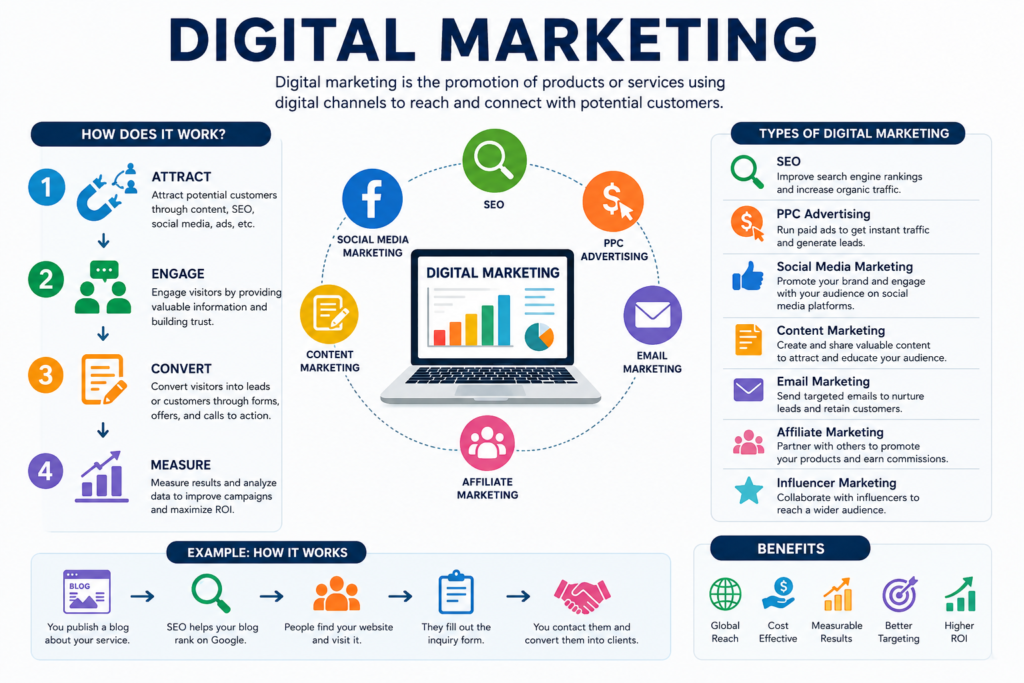
Digital marketing is the practice of promoting products, services, or brands through online channels such as search engines, websites, social media platforms, email, and mobile applications. Businesses use digital marketing to reach their target audience, generate leads, increase sales, and build long-term customer relationships.
Why Digital Marketing Is Important
In today’s connected world, consumers spend a significant amount of time online. Digital marketing helps businesses connect with potential customers where they already spend their time. Unlike traditional marketing, digital marketing provides measurable results, allowing businesses to track performance and optimize campaigns for better outcomes.
Key Benefits of Digital Marketing
- Cost-effective compared to traditional advertising
- Reaches a global audience
- Enables precise audience targeting
- Provides real-time performance tracking
- Improves brand awareness and visibility
- Increases website traffic and conversions
Types of Digital Marketing
1. Search Engine Optimization (SEO)
SEO is the process of improving a website’s visibility in search engine results. By optimizing content, keywords, and technical elements, businesses can attract organic traffic from search engines.
2. Content Marketing
Content marketing focuses on creating valuable and informative content such as blog posts, guides, videos, and infographics to attract and engage potential customers.
3. Social Media Marketing
Businesses use platforms like Facebook, Instagram, and LinkedIn to promote their products, interact with customers, and build brand awareness.
4. Pay-Per-Click (PPC) Advertising
PPC advertising allows businesses to display ads on search engines and other platforms, paying only when users click on the advertisement.
5. Email Marketing
Email marketing helps businesses communicate directly with customers through newsletters, promotional offers, and personalized messages.
6. Affiliate Marketing
Affiliate marketing involves partnering with individuals or organizations that promote products or services in exchange for a commission on sales.
How Digital Marketing Works
Digital marketing combines strategy, content creation, audience targeting, and performance analysis. Businesses identify their target audience, create relevant content, distribute it through appropriate channels, and measure results using analytics tools.
The typical process includes:
- Defining business goals
- Identifying the target audience
- Creating valuable content
- Promoting content through digital channels
- Tracking and optimizing performance
Digital Marketing vs Traditional Marketing
| Digital Marketing | Traditional Marketing |
|---|---|
| Measurable results | Limited tracking |
| Global reach | Mostly local reach |
| Lower cost | Higher advertising costs |
| Real-time optimization | Difficult to modify campaigns |
| Precise targeting | Broad audience targeting |
Future of Digital Marketing
Digital marketing continues to evolve with advancements in artificial intelligence, automation, voice search, and personalized customer experiences. Businesses that adapt to emerging trends can gain a competitive advantage and achieve sustainable growth.
Conclusion
Digital marketing is an essential strategy for businesses of all sizes. By leveraging SEO, content marketing, social media, email marketing, and online advertising, companies can increase their online presence, attract customers, and drive revenue growth. A well-planned digital marketing strategy helps businesses stay competitive in the modern digital landscape.